main content

Travel

Global briefing

  • Jihadist ideology is now under attack from its erstwhile proponents. A Libyan group has issued a new religious document denouncing the tactics used by al Qa'eda as illegal under Islamic law.

You make the news

Send us your stories and pictures

The beat moves on

Faisal al Yafai

  • Last Updated: October 17. 2009 1:33AM UAE / October 16. 2009 9:33PM GMT


In a city at the end of the world, I am speaking about dead men.

“The last time I saw Mohammed Hamri was 1998. We used to come to this cafe to drink. Paul Bowles I saw more, almost every month. I used to take writers over to his Old City flat; he didn’t go out much by then and he spoke very slowly.”

The words are from the Moroccan artist Abdel-Aziz Boufrakech and the names are from history. Amid the brown leather seats and mirrored interior of the Cafe de Paris in Tangiers, over mint tea, we are talking about the Beat Generation, a group of writers and artists working in the shadow of the Second World War. The cafe is unchanged since then, the people and furniture is as it was in the 1950s. Outside, the posters could be of King Mohammed V, rather than his grandson Mohammed VI. The sounds of an oud float inside.

Tangiers is Morocco’s forgotten city. Perched at the edge of the African continent as it curves towards Europe, it was for four decades orphaned from the rest of the country, declared an international zone and carved up between nine western nations. Morocco reclaimed it at independence in 1956, only to forget it. For years, Tangiers languished.

But it was in those lost decades that Tangiers became known to the West. In the shadowy world of the international zone, few laws applied and much that was illicit elsewhere thrived. Writers and artists from Europe and North America, men on the margins of their homelands, exiled themselves here, anonymous amid the illegality that flourished. Many of the Beat Generation, a group of American and Moroccan writers and artists active in the 1950s, passed through here. Paul Bowles, Brion Gysin, William S Burroughs all worked here – Bowles spent the majority of his life in Tangiers, while others like Tennessee Williams and Allen Ginsberg just passed by.

The Tangiers of that time was immortalised as the debauched, violent world of the Interzone in Burroughs’ Naked Lunch, creating a mythology that still stands.
Boufrakech is a living link to that time. One of the city’s great visual artists, he was born at the right time, the 1960s, to cross paths with the Beat Generation and see the transformation the years since have brought.

While the Cafe de Paris on Place de France has remained unchanged, although less frequented by literary lions than it was, the Medina of Tangiers, the city’s old heart, is being chipped away by modernity.


Start with the Petit Socco, where I first met Boufrakech, and the change is obvious. This bulge in the narrow streets of the medina is dominated by Cafe Central, formerly the gathering place for a rakish contingent of artists, the place to sip coffee and do deals of drugs and flesh. The cafe remains, but it has been cleaned up: dark rattan chairs, welcoming wood and suitably expensive prices.

The Petit Socco is now a big draw for the travellers and tourists who disembark from European ferries and make the long walk through the medina, past the shops that sell all the ornaments of the Maghreb, on to the green and white minaret of the Grand Mosque, to end up at the scenic lookout, staring east across the waves at the dim outline of Spain.

All around them, in gallabiyas and slippers or shirts and jeans, are locals and expats, shouting and whispering, selling and buying. There is an urgency to Tangiers now: the light that attracted painters like Matisse remains, but the subjects are keen to keep up with their entrepreneurial brothers in Casablanca and Marrakech.

The decadence – and the undertones of danger – that was so attractive to artists of the past is fading: in its place is a cleaner cultural renaissance. This summer the Tanjazz annual jazz festival celebrated its first decade. The Grand Socco, at the entrance to the medina, has been remade into a lush park. Standing over it is a revamped Cinema Rif, an expanse of whitewashed walls that hints at the glamour of old movies. Pastries, fruit cocktails and Wi-Fi have replaced alcohol and drugs as fuel for the new creatives.

“That world is not gone,” says Boufrakech, “But it doesn’t exist in the new parts of Tangiers. The lifestyle has gone. In those days we used to meet and talk about art and go to parties. With Hamri, we used to go to galleries or have a drink at the El Minzah. Now, we’ve lost all that.”

Perhaps no one embodies this change, this professionalisation, as much as El Abdi, the stepson of Mohammed Hamri, the most famous of Morocco’s Beat Generation. Hamri was an author and painter, most famous for his scenes of traditional Moroccan life. Hamri introduced Brion Gysin, the British author, and later the Rolling Stones’ Brian Jones, to Arabic music from the village of Jajouka, which brought the village’s musicians worldwide fame. He called himself the “painter of Morocco” and the name stuck; today, a decade after his death, his work can be found in collections across Europe and the US.


El Abdi was born to Hamri’s first wife, before they married. A precocious painter, he had his first exhibition – with Brion Gysin – at 20 and spent his formative years watching Hamri work. As we walk through the medina, the walls curving up all around us, he talks about the last remnants of the Beat Generation. “The places are still there – the Petit Socco is still there. But the people are different. Their ideas are different. What has really changed is that the way they used to live is gone. We still talk about them, so they had a long influence. But it’s not how we live now, to be stoned and sit in the cafes all day.” El Abdi still exhibits but makes his living in that most modern of artistic professions: design and advertising.

We duck into the gallery of the Ibn Khaldoun cultural centre, browsing the work on the white walls of some of Tangier’s best artists. “The art scene is better now,” he says. “There are more artists and more galleries. They sell more art and that promotes young artists. But” – he pauses – “it is mainly for show, for investment. They are not serious collectors.” He is reluctant to talk about his father’s work – I sense he is keen to be seen as an artist in his own right.

Galleries like this one are popping up across Tangiers: in the short time I am there, I am invited to the opening of four different shows. At the Ibn Khaldoun gallery, topics range from stylised representations of Moroccan women to Edvard Munch-like shadow figures. I note a small painting by Boufrakech is the gallery’s most expensive, on offer for US$3,000 (Dh11,000). A cluster of three small works in black ink draws my eye and I see the name beside them: Mohamed Mrabet, one of the last living members of the Beat Generation.

In the early hours of the morning, I am on the wide terrace at the top of Hotel El Muniria, being eaten alive by mosquitoes I cannot see. The room I am sleeping in is oppressively hot and thick with ghosts: this is where William Burroughs wrote Naked Lunch, the same room where Jack Kerouac languished in the years before On the Road was published. Downstairs is the Tanger Inn, a cramped bar painted red, heavy with Beat history.

On the walls hang photos of the authors, above descriptions written in Allen Ginsburg’s dense scrawl. I think back to 1957. The year after independence, the year after Ginsberg’s Howl. Today, backpacking teenagers whose parents were not yet born when Ginsberg wrote those words stare at them earnestly and sip beers.

Below me in the steaming city, a woman’s voice, mournful like Fairuz but not Fairuz, calls out lamentations for love. The voices of young men reply: not to her, but to each other, coming from clumps of three and four shouting against the night sky in the maze of streets below.

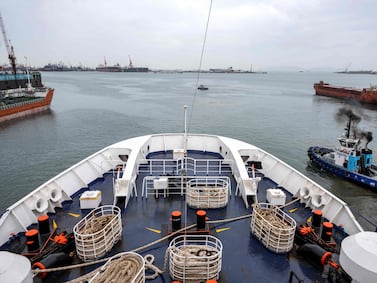
This is the Ville Nouvelle, the new part of Tangiers, where wide roads lined with boutiques and snack bars roll down to the sea. Faint red trails of cars’ rearlights snake along the coast road, the holidaying mix of Europeans, expats and Arabs going to dance to trance until the early hours at Club 555, or to lounge by the pool at La Pasarela, with the models and the moneyed. In the distance, the tourist ferries squat, their Christmas tree lights blinking, sentries of the last way out.

The artists for whom the Tanger Inn was a gathering point have moved on: don’t bother looking for them. You could walk from here north along Boulevard Pasteur and see only traditional cafes, small hotels and fashion stores. You could eat French cuisine to jazz, drink cocktails with free Spanish tapas and talk about the Asian economic climate. But don’t search for those old bohemians. One night, I am taken to a gallery opening off Rue Belgique. The crowd sips champagne and discusses the art, but there are no artists in attendance. The artists have been edged out of the Ville Nouvelle.


On the terrace I am thinking about Mrabet. These days he is best known as a painter but he was also a writer and storyteller. The American writer Paul Bowles translated many of his works and collaborated with him on several stories. Having lived the same louche lifestyle as his peers, he has somehow outlived them all. When he goes, I wonder, will the artistic history go with him? I need to find Mrabet and ask him. I drag an old chair out of my room and lie there in the darkness until the heat of the dawn wakes me up and the clouds drip purple in the sky.

The next day, I call Boufrakech and he promises to do what he can, but Mrabet is notoriously reclusive these days. We take a taxi to the far west of the city, to an alleyway of tall houses perched on a hill. And wait. Suddenly the phone rings and a woman in red emerges from one of the nearby buildings, beckoning us inside.

Upstairs, sitting on his knees surrounded by painting supplies and unfinished works is Mohamed Mrabet, a thin, gaunt man in his 70s with a still-powerful voice. The walls are covered with images from the past – there is Tennessee Williams in black and white, Paul Bowles unsmiling. But the figure that most often recurs is Mrabet himself, portraits of the artist as a muscular young man.

This fascination with the self is a recurring theme. He refers to himself in the third person. “Who will remember Tangiers after Mrabet is gone?” He says. “It is because of Mrabet that Europe remembers Tangiers. After, who will remember?” He speaks in a halting, dreamy tone, often using his hands to bat away the question, then answering a different one. “Everyone in Morocco thinks he is a painter. Everyone thinks he is a storyteller. But they tell their story only. Mrabet makes stories that are new and the whole world listens.”

His stories range across literary figures and I feel swamped by their proximity: he tells me how he met Tennessee Williams for the first time in 1961 in the Cafe de Paris. The writer – then reeling from the death of his partner – was staying at the El Muniria hotel. Half a century on, the two places still stand, the places in which I eat and sleep. He tells me stories of living with Williams in California, of his days working with Bowles, while he puffs on a long thin pipe.

But it is clear, for all his memories, that he feels forgotten by the city. “I don’t go to see paintings now,” he says. “It is all rubbish. There are no good painters in Morocco.” I see Boufrakech wince at this, but he is too polite to interrupt the older man. “It is all for money now, only for money.”

After some time, I stop asking questions and just listen to Boufrakech and Mrabet talk. Two generations of accomplished Moroccan artists, talking about the people and the past that connects them. Apart from the pipe and his colourful stories of writers, these days there is not much corruption about Mrabet. He even talks about religion, emphasising his Islamic faith and crediting God for his inspiration.


Mrabet talks and smokes. The daylight fades and the muezzin calls. He is becoming forgetful, telling the same stories but mixing up names. Soon Boufrakech and I say our goodbyes with much hand clasping and laughing. To clear my head, back in the Ville Nouvelle, I walk down the beach in the dark, crossing a wide expanse of sand before I reach the water. There is a couple whispering, against the background hum of voices from the cafes behind us. I am thinking about Mrabet, about how a man so associated with Tangiers can feel so forgotten by it.

Cities at the end of the world have no memory: they forget our trajectories through time. When you arrive in Tangiers, the past is left behind, unable to follow you. This is the dark undercurrent to the city and the reason so many came to the Interzone: to forget or to be forgotten.

The bandit days of the Beats are being erased. Like a misspent youth, the city is keen to forget its past until it is respectable enough to reminisce. The city has moved on.

The old artists have become characters in a book, stories on the wall. Tangiers, so long a crossroads to other places, is grasping for an identity of its own. Only when it finds a surer footing, will it reclaim its memories of the dead.

travel@thenational.ae


  • Send to friend
  • Print
  • Bookmark and Share
  • Bookmark & Share

Have your say


Please log in to post a comment