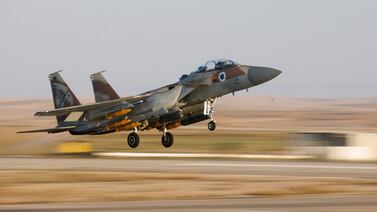
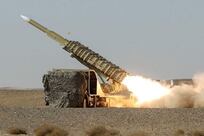
Global briefing
- News that Mahmoud al Mabhouh, a leading member of Hamas's military wing, the Ezzedine al Qassam Brigades, was murdered in Dubai 11 days ago, has quickly prompted speculation that Israel was behind the killing.
You make the news
Send us your stories and pictures
Eavesdropping sparks fresh border tension
Mitchell Prothero, Foreign Correspondent
- Last Updated: October 20. 2009 1:15AM UAE / October 19. 2009 9:15PM GMT
UN peacekeepers measure the crater where an Israeli spying device was blown up in Houla, Lebanon, near the border with Israel. AP Photo
BEIRUT // Hizbollah’s discovery of at least three eavesdropping devices planted in southern Lebanon by the Israeli military last weekend has inflamed an already tense border situation as the Lebanese armed forces fired anti-aircraft weapons at unmanned Israeli drones sent to survey the situation.
The situation began in the border village of Houla, a Hizbollah stronghold, on Sunday night, when, according to a statement by Hizbollah’s military wing, the Islamic Resistance discovered devices planted underground by Israel to spy on the group’s internal communications. One of those devices exploded on Sunday night.
“The Islamic Resistance has discovered a spying device installed by the Israeli enemy on a cable between the villages of Mays and Jebel after the 2006 war,” the Lebanese militant faction said in a statement.
“It was established that the device was booby-trapped and that the enemy had tried to blow it up once it knew it had been found out,” the statement added.
The devices were attached to Hizbollah communications lines and appeared to have been linked by cable to the Israeli side of the border, a couple of hundred metres away.
After Hizbollah informed the Lebanese military of the situation, according to military sources and local press accounts, army units sent to the area discovered at least two more devices on Sunday that also appear to have been programmed to either self-destruct or be blown up upon being discovered.
Members of Unifil, the UN’s interim force in Lebanon, arrived on the scene and helped with the disposal of the devices, which appear to violate conditions of the ceasefire that ended the war between Israel and Hizbollah in July 2006. “Preliminary indications are that these explosions were caused by explosive charges contained in unattended underground sensors which were placed in this area by the Israel Defence Forces apparently during the 2006 war,” Unifil said in a press statement.
Unifil has described the existence of Israeli spy networks in south Lebanon and the presence of Hizbollah weapons caches as significant violations of the terms of the ceasefire.
According to As-Safir, a Lebanese daily newspaper that has close ties to Hizbollah, the discovery “proves that the resistance is ready for any development with the enemy and shows co-ordination between the army and the resistance”.
“This proves Lebanon is no longer safe ground for enemy agents’ operation or its spy devices,” the paper concluded.
The discoveries and subsequent explosions come just a week after a mysterious explosion ripped apart the home of a Hizbollah commander who had been storing weapons in his village, an event the group has alleged was the result of Israeli sabotage.
Israel and Hizbollah have been engaged in a tense war of intelligence gathering and name-calling over the past year even though the border continues to be relatively quiet in terms of direct military action. More than 70 Lebanese residents have been arrested and charged with spying for Israel, while Israeli commandos helped several other suspected spies escape across the closed border between the two countries, drawing heated protests from the Lebanese government.
For its part, Israel has contended that Hizbollah continues to maintain arms caches south of the Litani River, along the Israeli-Lebanese frontier in violation of the 2006 ceasefire. Hizbollah does not comment on the record on military subjects.
After the explosions on Sunday, the Lebanese army informed Unifil that it would no longer ignore Israeli overflights of Lebanon, which have continued unabated for decades. Israel claims the flights are needed to monitor Hizbollah’s refusal to follow the terms of the ceasefire, while Lebanon describes them as a breach of the agreement.
Although Lebanon’s anti-aircraft weaponry poses little threat to Israel’s warplanes, anti-aircraft fire on Sunday appeared to be enough to deter drones from staying over the area of the discovery.
The devices laid by Israel appear to be attempts to tap into Hizbollah’s modern and secure fibre-optic communications network, which links its fighters to central command and control facilities. Hizbollah closely guards information and access to its communications networks, and an attempt by its rivals in the government to shut the network in 2008 led to a bloody takeover of West Beirut by Hizbollah and its allies.
Have your say
Other World stories
Your View
- Are you concerned with the standard of education your children receive?
- What would you like to see included in the new law on smoking?
- What can be done to ease the increasing cat population in the UAE?
- Would you hand back Dh5m if you found it in your bank account by mistake?
- What would you like to see in the new code of conduct for schools?
Most popular stories
- The apartheid will end when Israelis have to face its cost
- Dubai Metro's music causes disharmony
- Education faces up to double challenge
- Police raid illegal plastic surgery clinic
- UAE banks’ debt woes to grow
- For Burj refunds, go to Dubai
- New guide to being a better boss
- Hunt for mother of abandoned baby
- Interpol warrant for runaway fraudster
- Faulty lift to blame for Dubai tower shutdown