Global briefing
Week in review: Al Qa'eda denounced by Libyan group
- Jihadist ideology is now under attack from its erstwhile proponents. A Libyan group has issued a new religious document denouncing the tactics used by al Qa'eda as illegal under Islamic law.
You make the news
Send us your stories and pictures
e-poll
The world celebrates the 40th birthday of the internet, but would you say your life is better for it?
Plastic
Cash
Saudi provides realistic outlook on energy future
Mohamed A Ramady
- Last Updated: September 06. 2009 8:36PM UAE / September 6. 2009 4:36PM GMT
Peak oil predictions – including that dreaded day when the maximum rate of extraction is reached, after which the rate of production enters decline, leading to depletion of reserves – are back.
Unlike some previous forecasts, recent reports are more sober.
The debate on output highlights the Saudi government’s increasing calls for a more “equitable” oil pricing level at US$75 a barrel. This would encourage continuous investment in this vital energy sector, while at the same time ensuring that peak oil thresholds are pushed back.
Saudi pleas seem to have fallen on deaf ears, as recession-hit Western governments are loath to see higher energy prices for domestic political reasons. This comes almost a year after oil prices hit peaks of $147 a barrel and the same leaders were trooping to Saudi Arabia to literally beg for increased oil production to bring prices down.
Such oil price uncertainties are pushing some western governments to opt for policies of “energy independence” and this is rankling with Saudi Arabia, which accuses such countries of double standards when it comes to dealing with the kingdom.
On the one hand they are eager for the kingdom to increase production and hold other members of OPEC in check when they call for higher oil prices, while at the same time publicly pursuing alternative energy sources to reduce dependency on Saudi oil.
Despite such wishful thinking on energy independence, the world’s engine of economic growth will always include a mix of renewable and non-renewable fuels, which is in the best long-term interest of oil consumers and producers.
It is not such a bizarre idea to note that one major oil producer, the UAE, is encouraging alternative energy research through the acclaimed Abu Dhabi Future Energy Company (Masdar).
The collapse of oil prices to the $30-$45 levels was a short-term blessing that masks the urgency of the Saudi warning that more, and not less, investment is now needed.
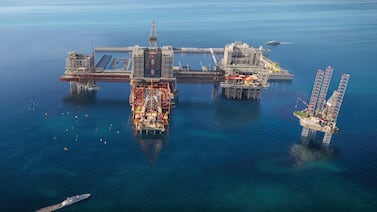
The kingdom is going ahead on its own and plans to invest more than $400 billion (Dh1.46 trillion) in upstream and downstream projects to increase its production capacity to 16 million barrels per day (bpd) over the next 15 years.
For the world to avoid the doomsday pricing scenario of oil shortages, other countries must step up and provide their private sector oil companies with tax incentives and other financial inducements to continue exploration investment.
Peak oil supporters and their opponents are bitterly divided on the subject of production, as all numbers tend to be estimates.
Some countries see the size of their oilfields as a national security issue and do not want to provide accurate information, an accusation that the West makes against certain OPEC members.
Another problem concerns how fast oil production is declining in fields that are past peak production. The rate of decline can vary from field to field, and this affects calculations on the size of the reserves.
The International Energy Agency (IEA), meanwhile, has done some homework on the subject and the first detailed assessment of more than 800 oilfields covering three quarters of global reserves has found that most of the biggest fields have already peaked. It also found that the rate of decline in oil production is now running at nearly twice the pace that it calculated just two years ago.
The IEA estimates that the decline in oil production in existing fields is now running at 6.7 per cent a year compared to the 3.7 per cent decline it estimated in 2007, a figure it now acknowledges to be wrong.
On top of this, there is a problem of chronic underinvestment by oil-producing countries – with the exception of Saudi Arabia and the UAE to a lesser extent – a feature that is set to result in an “oil crunch” within the next five years.
The implications are many: more energy market concentration in a few, predominantly Middle East hands, with future accusations of oil pricing “blackmail” and geopolitical tensions and rivalries in the region.
Even if demand remained steady, the world would have to find the equivalent of four Saudi Arabias to maintain production, and six Saudi Arabias if it is to keep up with the expected increase in demand between now and 2030.
Unlike earlier periods of oil supply lagging behind demand, this time Saudi Arabia is giving ample warning to do something, otherwise not to blame it and other oil producers for the consequences that will make $147 a barrel oil seem a blessing by comparison.
It behoves the world to take the Saudi warning very seriously. Like it or not, the fates of oil consuming countries such as the US to that of Saudi Arabia are connected and will remain so for decades to come.
Dr Mohamed A Ramady is a former banker and visiting associate professor, finance and economics at King Fahd University of Petroleum and Minerals, Dhahran, Saudi Arabia
Most popular stories
- Tipping pointers: your gratuity guide
- Crown Prince tells World Economic Forum UAE economy is ‘humming’
- The debt collectors
- Something to sink his teeth into
- Manny Pacquiao: Thriller from Manila
- Westwood remains on course
- Emaar chairman bullish on Dubai
- Restoring more than metal
- Bin Suleiman replaced as governor of the DIFC
- 10,000 walk Yas circuit for diabetes


Added: 09/17/09 11:10:00 PM
The credit crunch is not entirely a sector pariah. It has shown to be an opportunity for stakeholders to re-write contracts with as much as 30% savings from the heady days of 2008Q1. Let us not be distracted by the smoke & mirrors of McPeaksters. They have been forecasting the demise of maximum oil production annually since 1989. They should not to be taken seriously.
If instead one listens to the top 20 geologists in the energy sector, we find that the average of their models projects that Peak Oil will not prevail 'til 2023; will rise from today's 84 million barrels/day flow rate to 93; and only 27% of available resource has been consumed: http://www.trendlines.ca/scenarios.htm
Freddy Hutter, Marsh Lake, The Yukon
Added: 09/07/09 10:40:00 AM
There is an innovative technology for oil/gas detection providing above three discoveries in four wildcats instead of one. See: http://www.binaryseismoem.weebly.com
Andrey Berg, San Jacinto
Added: 09/07/09 03:57:00 AM
Hello Dr. Ramady,
IMO, it would be fascinating if you would write a series of TOD keyposts on KSA' views of the ASPO Oil Depletion Protocols, Simmons' oilfield audit request, and how KSA plans to best handle ELM. Thxs for any reply.
TOD = TheOilDrum.com
Google ASPO Oil Depletion Protocols, Matthew R. Simmons [author of "Twilight in the Desert"], Jeffrey Brown Export Land Model
Bob Shaw in Phx,Az Are Humans Smarter than Yeast?
bob shaw, phoenix